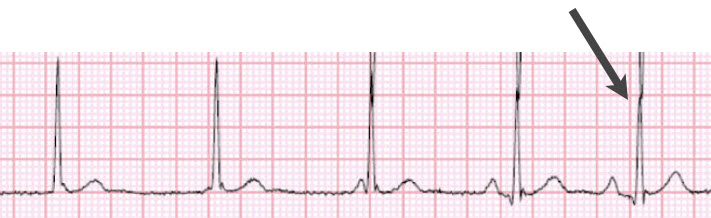
Capture Beat
A capture beat is a narrow QRS complex that appears during a run of ventricular tachycardia (VT) when a supraventricular impulse briefly “captures” the ventricles, producing a normally conducted beat amid wide‑complex VT.
Electrophysiologic Mechanism
During VT, the ventricles are being activated by an ectopic ventricular focus. If a sinus or atrial impulse happens to reach the AV node at a moment when:
- the AV node is not refractory, and
- the His–Purkinje system is not refractory,
…the supraventricular impulse can transiently override the ventricular focus and depolarize the ventricles normally.
This produces a single, narrow, normal‑looking QRS within a sequence of wide VT complexes.
A capture beat is therefore proof of AV nodal–His–Purkinje participation, and by extension, proof that the underlying rhythm is ventricular, not supraventricular.
ECG Appearance
A single narrow QRS complex within a run of wide, monomorphic VT
The captured beat resembles the patient’s baseline QRS
Timing corresponds to a sinus P wave (if visible)
Often accompanied by fusion beats in the same rhythm strip
Common Misinterpretations
- Mistaken for a PVC “resetting” the rhythm
- Misread as a supraventricular beat with aberrancy
- Overlooked entirely when P waves are not visible
- Clinical Implications
Strongly supports the diagnosis of ventricular tachycardia - Helps differentiate VT from SVT with aberrancy
- No treatment is directed at the capture beat itself; management targets the VT
Clinical Implications
Strongly supports the diagnosis of ventricular tachycardia
Helps differentiate VT from SVT with aberrancy
No treatment is directed at the capture beat itself; management targets the VT
Related Terms
Fusion beat
Ventricular tachycardia
Supraventricular capture