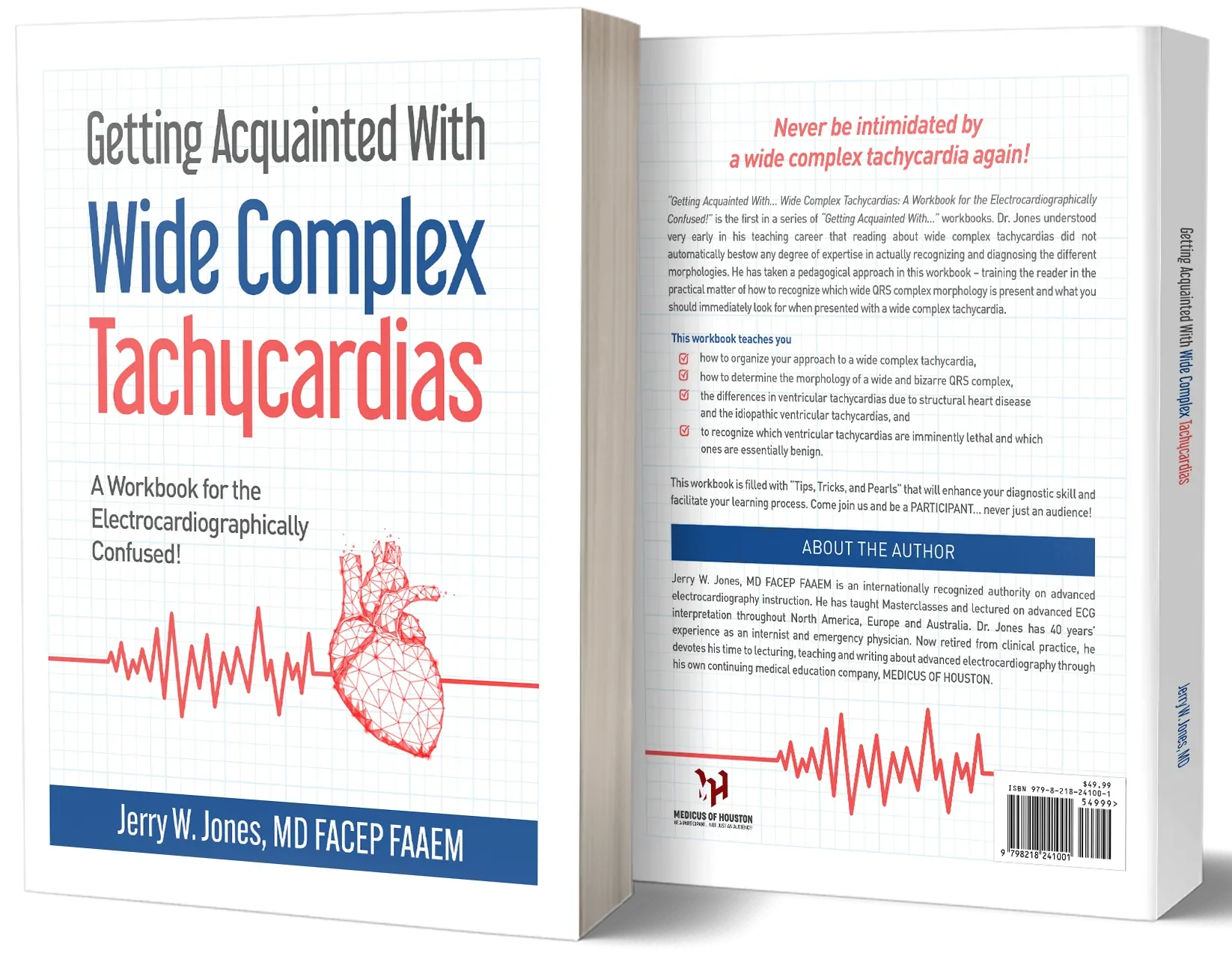
By Jerry W. Jones, MD FACEP FAAEM
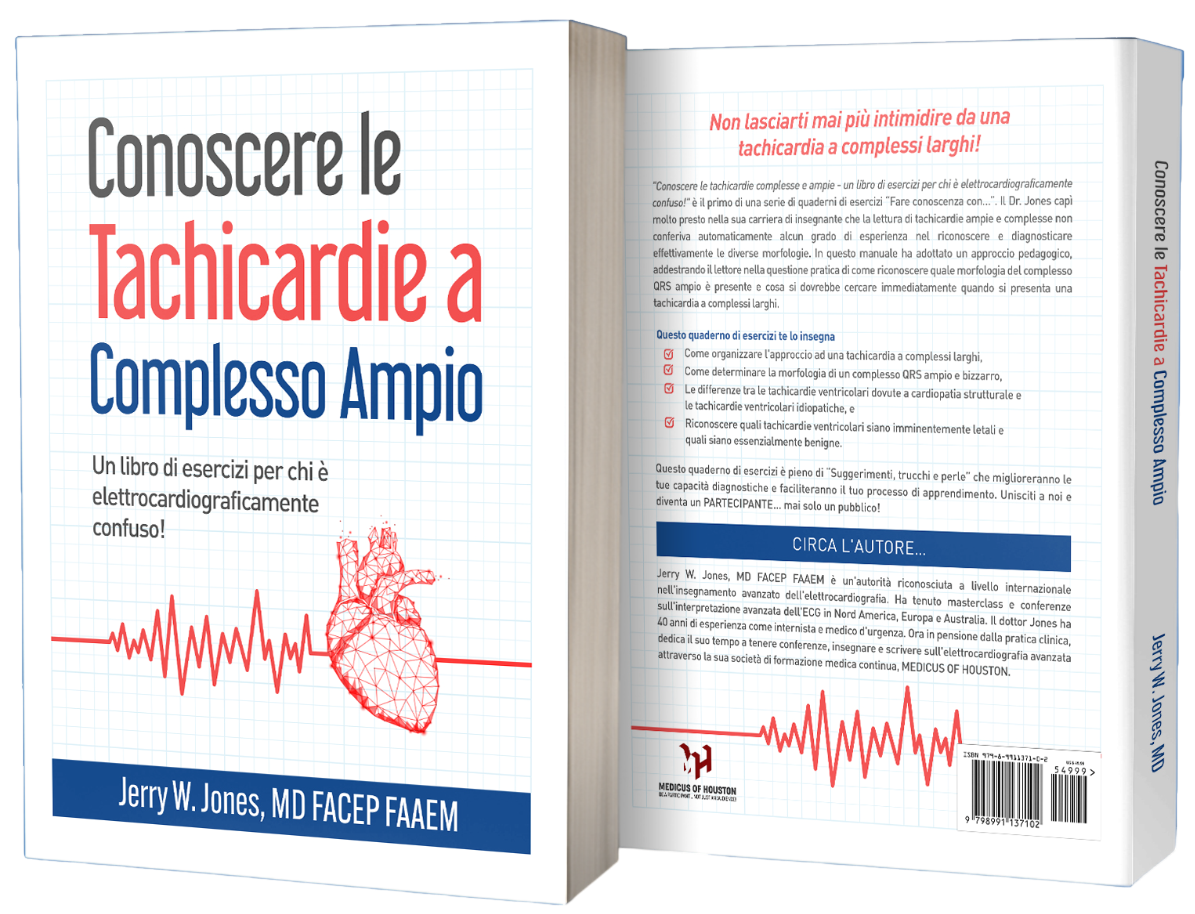
Now available as a first‑of‑its‑kind ECG interpretation reference, this advanced ECG course provides a comprehensive framework for high‑level ECG interpretation of ventricular tachycardia and other wide complex tachycardias. It integrates electrophysiologic principles with morphology‑based analysis to help clinicians distinguish ventricular tachycardia from supraventricular wide complex rhythms, even in challenging or atypical presentations. You can trust Medicus of Houston and Jerry W. Jones, MD FACEP FAAEM to bring you the best in ECG interpretation books for clinicians.
Mechanistic understanding of wide complex tachycardia — including ventricular origin, aberrant conduction, fascicular pathways, and His‑Purkinje involvement.
Diagnostic algorithms and criteria — such as axis evaluation, concordance patterns, bundle‑branch block morphology analysis, and recognition of capture and fusion beats.
Pattern recognition skills — training clinicians to identify subtle deflections, intraventricular conduction delays, and morphologic clues that reveal the site of origin.
Case‑based interpretation — real ECG examples that reinforce rapid, accurate differentiation of ventricular tachycardia from its mimics.
The workbook strengthens diagnostic precision across cardiology, emergency medicine, and critical care by combining electrophysiology, morphology assessment, and structured reasoning. By the end, clinicians can determine the ventricular origin of a tachycardia within seconds and approach wide complex ECGs with greater confidence and accuracy. This book is a great accompaniment for The Masterclass in Advanced Dysrhythmias!
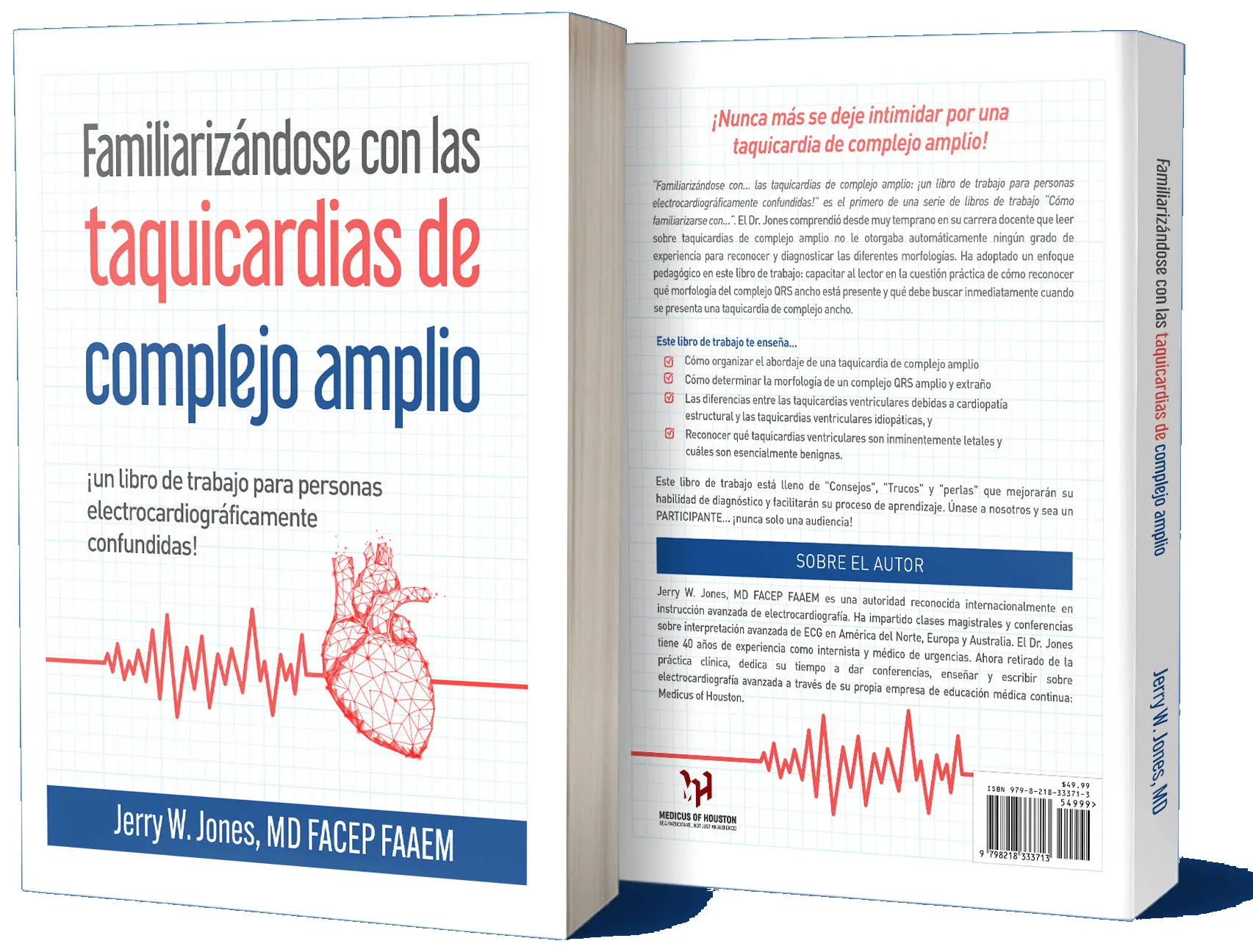
Print Edition
Edición impresa
Edizione cartacea
Maintenant disponible sur Amazon ! Le premier cahier d’exercices du genre traduit en français.
Édition imprimée
Já disponível na Amazon.com! Este é o primeiro livro de exercícios do gênero.
Edição impressa
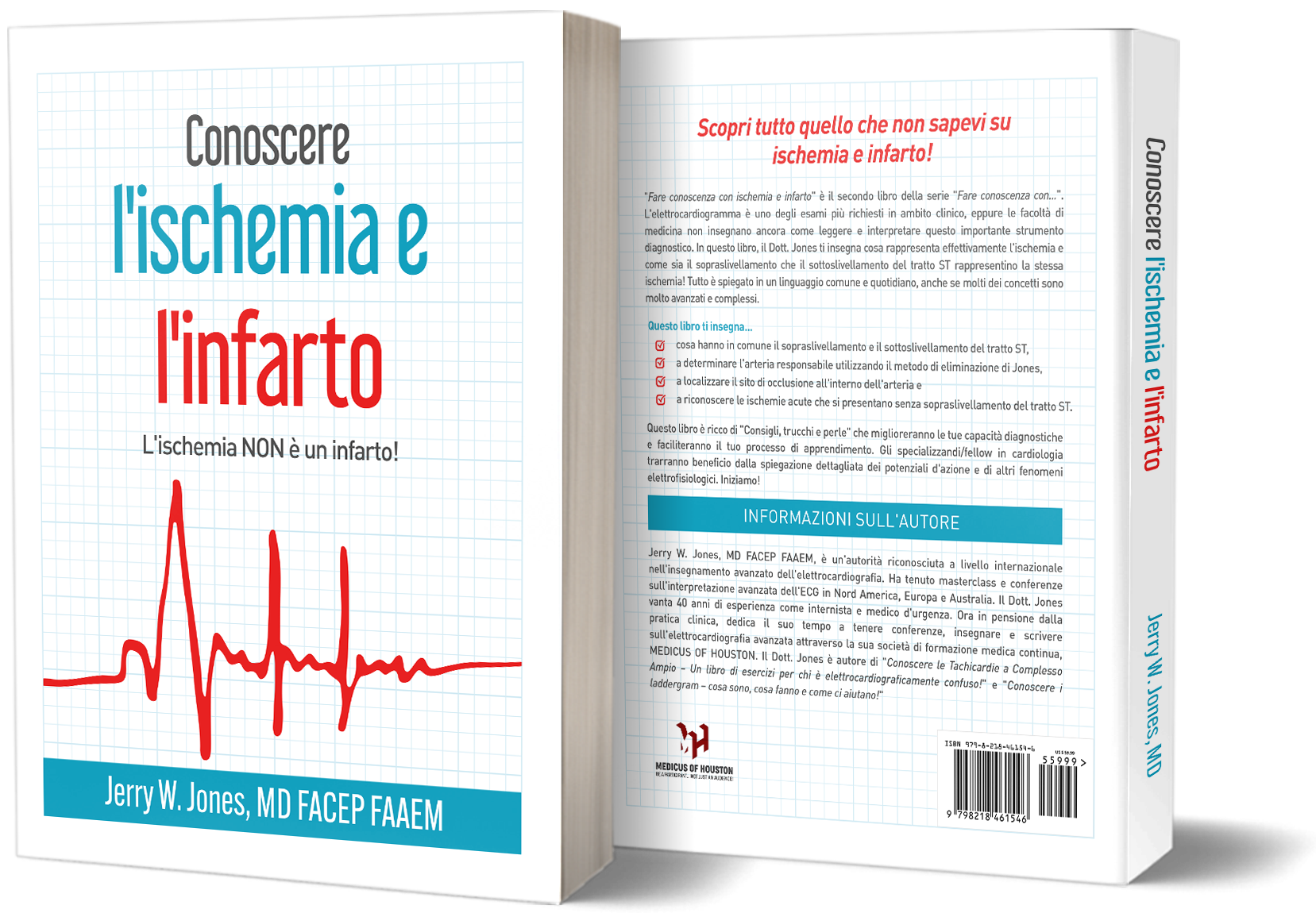
Now available on Amazon, this clinically focused reference delivers a comprehensive framework for identifying Occlusion Myocardial Infarction (OMI) using high‑precision ECG interpretation and ischemic pattern recognition. It emphasizes the electrophysiologic basis of ischemia, detailing how coronary occlusion produces specific ECG patterns—from subtle repolarization abnormalities to high‑risk morphologies that traditional STEMI criteria often miss. This book is a “must-have” for The Masterclass in Advanced Electrocardiography where an entire DAY is spent learning about ischemia and infarction!
Core ischemic ECG physiology — how transmural and subendocardial ischemia alter vectors, ST‑segments, T‑waves, and QRS morphology.
OMI pattern recognition — including hyperacute T‑waves, reciprocal changes, de Winter patterns, posterior MI equivalents, and terminal QRS distortion.
Differentiating OMI from mimics — such as LVH, LBBB, early repolarization, pericarditis, and non‑occlusive ischemia.
Case‑based interpretation — real‑world ECGs that illustrate both classic and subtle occlusion patterns.
The book strengthens diagnostic accuracy across cardiology, emergency medicine, and critical care by integrating electrophysiology, morphology analysis, and clinical context. It equips clinicians to detect acute coronary occlusion earlier, interpret ischemic ECGs with greater nuance, and avoid missed OMI presentations that fall outside STEMI criteria.

Print Edition
Edición impresa
Edizione cartacea
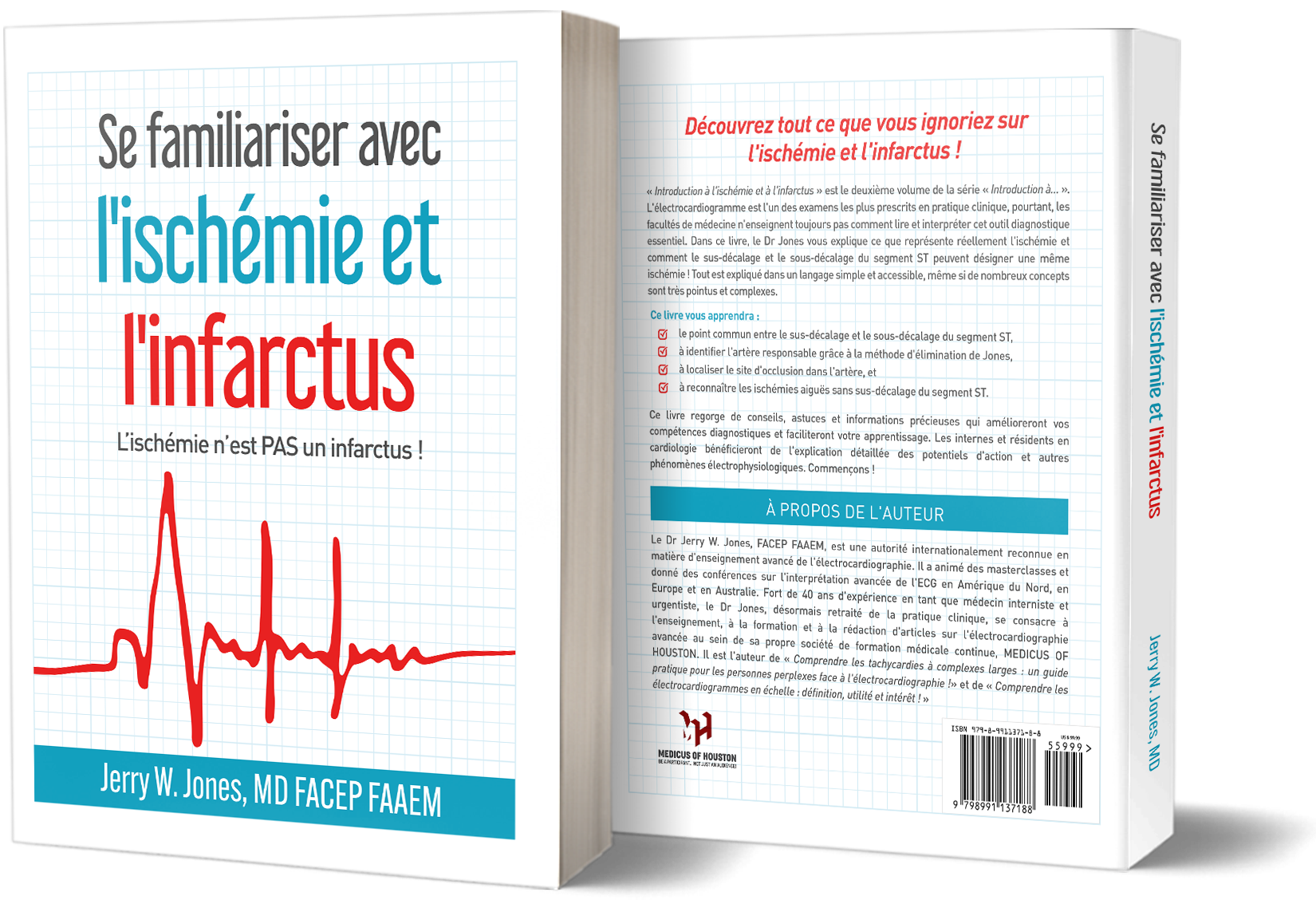
Maintenant disponible sur Amazon ! Le premier cahier d’exercices du genre traduit en français.
Édition imprimée
Já disponível na Amazon.com! Este é o primeiro livro de exercícios do gênero.
Edição impressa
Now Available On Amazon & Barnes & Noble
Did you know that every ECG is actually TWO ECGs – one (the atrial ECG) superimposed upon the other (the ventricular ECG)? Wouldn’t it be helpful if you could separate them and view the full ECG with less confusion?
Now available as a specialized electrophysiology resource, this advanced guide offers a comprehensive framework for understanding and constructing laddergrams, a powerful visual tool for high‑level ECG interpretation of conduction disturbances, arrhythmia mechanisms, and complex atrioventricular relationships. It bridges surface ECG findings with underlying electrophysiologic behavior, allowing clinicians to map impulse formation, propagation, and block with clarity that standard ECG analysis alone often cannot provide.
Foundational laddergram principles — including representation of atrial, AV nodal, His‑Purkinje, and ventricular activity, and how these components interact during normal and abnormal conduction.
Mechanism‑level interpretation — illustrating Wenckebach periodicity, AV nodal block, infranodal block, concealed conduction, junctional rhythms, and retrograde activation using precise laddergram construction.
Integration with real ECGs — teaching clinicians to translate surface ECG findings into laddergram form, revealing hidden conduction patterns, timing relationships, and the true mechanism behind arrhythmias.
Case‑based application — step‑by‑step examples that demonstrate how laddergrams clarify ambiguous rhythms, differentiate similar‑appearing arrhythmias, and expose conduction pathways that are not immediately evident on the ECG.
The book strengthens diagnostic accuracy across cardiology, electrophysiology, emergency medicine, and critical care by combining structured reasoning with visual electrophysiologic modeling. By mastering laddergram construction and interpretation, clinicians gain a deeper understanding of arrhythmia mechanisms and can analyze complex ECGs with greater precision, confidence, and insight.
Print Edition
Jerry W. Jones, MD FACEP FAAEM, is an emergency physician, senior medical educator, and the founder of Medicus of Houston. An internationally recognized authority in mechanism‑based ECG and dysrhythmia interpretation, Dr. Jones has spent more than two decades teaching clinicians how to move beyond pattern‑matching and develop true electrophysiologic understanding. His work has shaped the diagnostic approach of thousands of physicians, PAs, NPs, and paramedics across the United States and throughout the world.
Dr. Jones’s textbooks translate complex electrophysiology into clear, clinically actionable frameworks that improve accuracy and confidence in high‑stakes environments. Each volume reflects his academic rigor, his commitment to bedside relevance, and his belief that clinicians deserve explanations—not mnemonics. His books have become essential reading for those seeking deeper mastery of the electrocardiographic recognition of ischemia, infarction, wide‑complex tachycardias, and laddergram analysis.
Follow Dr. Jones on LinkedIn where he has a following of greater than 24,500 healthcare professionals.