
Ashman-Gouaux Phenomenon
The Ashman–Gouaux Phenomenon is a form of rate‑dependent aberrant ventricular conduction in which a supraventricular impulse is conducted with a wide QRS complex, typically showing right bundle branch block (RBBB) morphology, when a short R‑R interval follows a relatively long R‑R interval. It is most commonly observed in atrial fibrillation, but may occur in any supraventricular rhythm with variable cycle lengths.
Electrophysiologic Mechanism
The phenomenon reflects the fundamental relationship between cycle length and refractoriness in the His–Purkinje system. After a long R‑R interval, the refractory period of the conduction system—especially the right bundle, which normally has a slightly longer refractory period—becomes prolonged. If a short cycle follows immediately, the supraventricular impulse may arrive before the right bundle has recovered, producing a functionally aberrant beat with RBBB morphology.
This “long–short” sequence is the classic setup, though a short–long–short pattern increases the likelihood of aberrancy even further.
Because the impulse originates above the ventricles, Ashman beats are supraventricular in origin, despite their wide QRS appearance. This distinction is clinically important because Ashman aberrancy is frequently mistaken for premature ventricular complexes or even nonsustained ventricular tachycardia.
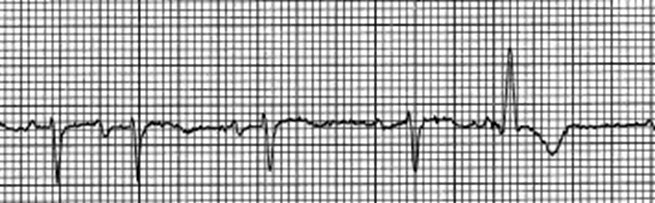
ECG Appearance
Typical features include:
- A wide QRS complex following a short R‑R interval that is preceded by a long R‑R interval
- RBBB‑type morphology (most common)
- Irregular coupling of aberrant beats
- Absence of a fully compensatory pause
- Occurrence during atrial fibrillation or other supraventricular rhythms with variable cycle lengths
These characteristics help differentiate Ashman aberrancy from ventricular ectopy.
Clinical Significance
Ashman–Gouaux Phenomenon is benign and represents normal physiology of the conduction system under varying cycle lengths. It does not require treatment, and management focuses on the underlying supraventricular rhythm, most commonly atrial fibrillation.
The primary clinical importance lies in recognition, as misinterpreting Ashman beats as ventricular arrhythmias may lead to unnecessary antiarrhythmic therapy, inappropriate cardioversion, or misdiagnosis of ventricular tachycardia.
A related concept, concealed perpetuated aberrancy (concealed transseptal conduction), explains why aberrant conduction may persist for several beats even after cycle lengths normalize, due to concealed retrograde penetration of the bundle branches.
Common Misinterpretations
- Mistaking Ashman beats for PVCs
- Misdiagnosing wide‑complex tachycardia as ventricular in origin
- Assuming aberrancy requires treatment
- Overlooking the long–short sequence that precedes the aberrant beat
Related Terms
- Rate‑dependent aberrancy
- Right bundle branch block
- Atrial fibrillation
- Concealed conduction
- Wide‑complex tachycardia (differential diagnosis)