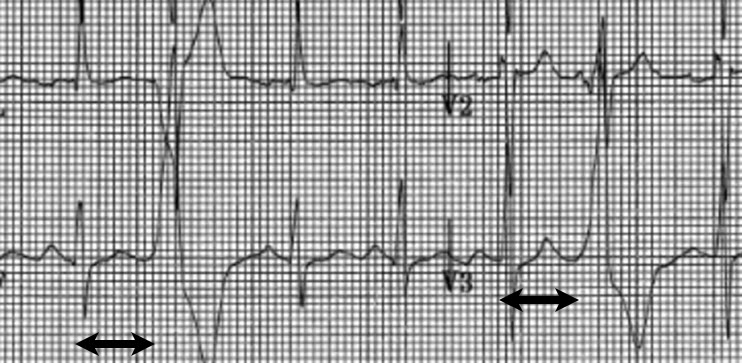
Coupling Interval
The coupling interval is the time between a normal sinus beat and a premature beat (PAC or PVC). It reflects the timing relationship between ectopic activity and the preceding cycle.
Electrophysiologic Mechanism
Ectopic impulses arise from irritable atrial or ventricular foci. The timing of these impulses relative to the preceding beat depends on:
- automaticity
- triggered activity
- reentry timing
- refractory periods
A fixed coupling interval suggests a reentrant or triggered mechanism.
A variable coupling interval suggests enhanced automaticity.
The coupling interval influences:
- aberrancy
- compensatory pauses
- bigeminy/trigeminy patterns
- risk of R‑on‑T phenomena
ECG Appearance
Measured from the R wave of a normal beat to the R of the ectopic beat or P wave of a normal beat to the P wave of the ectopic beat
PVCs often show a fixed coupling interval
PVCs with variable coupling suggest ventricular parasystole
PACs may show variable coupling
Short coupling intervals increase the risk of R‑on‑T events
Common Misinterpretations
- Confusing coupling interval with cycle length
- Assuming all PVCs have fixed coupling
- Mislabeling variable coupling as “random” ectopy
Clinical Implications
Helps determine the mechanism of ectopy
Short coupling intervals may indicate higher arrhythmic risk
Useful in differentiating PACs from PVCs when morphology is ambiguous
Related Terms
Compensatory pause
Bigeminy
Premature ventricular contraction