
Reciprocal Changes in Acute Myocardial Ischemia: From Myth to Mastery
Jerry W. Jones, MD FACEP FAAEM
Abstract
Reciprocal ST-segment changes — defined as ST-segment depression occurring in any electrocardiographic lead whose axis forms an angle greater than 90° with the injury current vector — are among the most clinically important phenomena in acute coronary care. A lead records a positive deflection when the injury vector falls within its positive hemifield and a negative deflection when the vector enters its negative hemifield; the perpendicular (90°) is the transition point, and the magnitude of reciprocal depression follows a cosine function (more on this later), reaching its maximum at 180°.1-2 Present in approximately 77% of patients with an acute occlusion of a coronary artery or major branch (STEMI/OMI), reciprocal changes serve as diagnostic markers that 1) help distinguish STEMI/OMI from its mimics, 2) localize the culprit coronary artery, and 3) provide prognostic information regarding infarct size, left ventricular function, and mortality. This review examines the electrophysiologic basis of reciprocal changes and explains why the ST segment is the only ECG deflection that reliably demonstrates reciprocal behavior (sorry, T wave!).
I. Introduction
The standard 12-lead electrocardiogram (ECG) remains the cornerstone of acute myocardial infarction diagnosis. Among its many features, reciprocal ST-segment changes occupy a unique position: they are one of the earliest recognized ECG phenomena in acute coronary syndromes and will occasionally appear even before the primary ST elevation of the ischemic area. Reciprocal changes are defined as ST-segment depression occurring in any lead whose axis forms an angle greater than 90° with the injury current vector — that is, any lead whose positive pole lies within the negative hemifield of the vector and within the same plane.1-3 The magnitude of this reciprocal depression follows a cosine function, beginning at the perpendicular (90°) and reaching its maximum when the lead axis is oriented 180° from the vector.2-3 This cosine function means that the angle the injury current vector makes with a lead axis determines the amount of ST elevation (or reciprocal ST depression) in that lead (don’t worry – you needn’t remember any trigonometry).
First described in the early decades of clinical electrocardiography, these changes have been variously interpreted as benign electrical artifacts (they are NOT!), markers of extensive myocardial injury (that is TRUE!), and indicators of remote ischemia threatening myocardium distant from the primary infarct zone (a theory no longer favored).
The clinical importance of reciprocal changes extends across multiple domains. Diagnostically, their presence strongly favors acute transmural ischemia over conditions that may mimic ST-segment elevation, including acute pericarditis, early repolarization patterns, left ventricular hypertrophy, and Takotsubo syndrome.4
Prognostically, reciprocal changes are associated with:
- larger infarct size,
- lower left ventricular ejection fraction,
- multivessel coronary artery disease, and
- increased mortality.5
Basically, the reciprocal changes mirror the gravity of the ST elevation which they reflect. Therapeutically, the pattern and distribution of reciprocal changes can guide identification of the culprit coronary artery and the level of occlusion, informing decisions about revascularization strategy.1,6
This review aims to provide a comprehensive synthesis of the current understanding of reciprocal ST-segment changes, with particular attention to the electrophysiologic principles that make the ST segment — and not the T wave — the only ECG deflection that reliably demonstrates reciprocal behavior.
II. Electrophysiologic Basis of Reciprocal Changes
An understanding of reciprocal ST-segment changes requires consideration of several fundamental bioelectric principles governing the 12-lead ECG.1
The most basic principle is that each impulse is a vector – and a vector is a dipole, meaning that it can be depicted as an arrow with a positive end and a negative end – the polarity (positive and negative ends) make it a dipole (“two poles”). The depolarization vector and the current of injury vector (usually just called the injury vector) both have a positive head (the “sharp” end) and a negative tail (the “feathered” end). The repolarization vector is just the opposite – it has a negative head and a positive tail. Whichever “end” of the vector is facing a recording electrode will directly affect the way its Impulse is inscribed on the ECG. Note: it does NOT matter if the vector is traveling TOWARD or AWAY FROM the electrode. It will simply record what it sees. If the electrode for Lead V5 sees the depolarization vector traveling toward it – it will inscribe a POSITIVE (upright) QRS complex because it sees the POSITIVE head coming toward it. If it sees the repolarization vector traveling AWAY FROM it, it will inscribe a POSITIVE (upright) T wave because it sees the POSITIVE tail of the vector – even though it is traveling away from it.
Another principle concerns the geometric relationship between the injury vector and the lead axis. Each ECG lead has a positive hemifield — the 180° arc centered on its positive pole — and a negative hemifield — the 180° arc centered on its negative pole. A lead records a positive deflection (ST-segment elevation) when the injury vector falls within its positive hemifield and a negative deflection (ST-segment depression) when the vector falls within its negative hemifield.1-2 The transition from positive to negative — the point at which reciprocal ST-segment depression begins — occurs the moment the injury vector crosses just 1° past the perpendicular of that lead’s axis. A lead whose axis is exactly perpendicular to the injury vector records an isoelectric ST segment; once the vector moves even slightly into the negative hemifield, ST depression appears1-2, though, granted, one would be most unlikely to detect such a miniscule change on the ECG.
The magnitude of the reciprocal deflection is a function of the angle between the injury vector and the lead axis. At 0° (vector aligned with the positive pole), the projection is maximal and positive (maximum ST elevation). At 90° (perpendicular), the projection is zero (isoelectric). At 91°, the projection becomes minimally negative (onset of reciprocal depression). At 180° (vector aligned with the negative pole), the projection is maximal and negative (maximum reciprocal ST depression).1-2 This relationship explains why the conventional teaching that reciprocal changes occur in leads “180° opposite” is an oversimplification: 180° is the angle of maximal reciprocal depression, but the onset of any reciprocal depression occurs at the perpendicular. The magnitude of ST-segment elevation and its reciprocal depression may not be identical because of…
- differences in the distance of the recording leads from the ischemic region,
- the amount of conducting and non-conducting tissue intervening between the ischemic area and the recording electrode, and
- the angular deviation of the leads from being precisely 180° opposite to each other.1
This geometric principle also explains the clinical observation that Lead aVL is exquisitely sensitive to reciprocal changes during inferior STEMI/OMI. The AHA/ACCF/HRS scientific statement notes that Lead aVL frequently has a spatial orientation that is approximately perpendicular to the mean QRS vector (usually aligned with the Lead II axis).1 During acute inferior transmural ischemia, the injury vector is directed inferiorly (toward +90° in the frontal plane), placing it near the perpendicular of aVL’s axis (−30°). Even a small shift in the injury vector’s direction can move it from Lead aVL’s positive hemifield into its negative hemifield, causing Lead aVL to flip from isoelectric to depressed with minimal angular change. This perpendicular sensitivity makes Lead aVL one of the earliest and most reliable leads for detecting reciprocal changes in inferior infarction, in other words, it is very sensitive to any slight deviation of the current of injury vector.1
If no body surface lead has its axis oriented more than 90° from the injury vector, then only ST-segment elevation — but not reciprocal depression — will be displayed on the routine 12-lead ECG This can be seen occasionally with some occlusions of the LAD. Conversely, if the injury vector falls within the negative hemifield of multiple leads, reciprocal depression will appear in all of them, with the magnitude proportional to the angle between the vector and each lead’s axis.1 This is essentially what happens when there is a circumferential subendocardial ischemia with ST elevation in Lead aVR and ST depression in most of the remaining leads.
The injury currents associated with acute ischemia (transmural or not) and infarction may cause ST-segment elevation, ST-segment depression, both, or neither in any body surface lead, depending on five factors:
- the location of the recording electrode;
- the relationship between the positive and negative poles that determine the spatial orientation of the lead;
- the location of the ischemic region;
- the magnitude of the voltage transmitted to the body surface; and
- the presence of confounding ECG abnormalities such as left ventricular hypertrophy with secondary ST-T wave changes, intraventricular conduction disturbances, or pericarditis.1
Noriega et al. demonstrated in porcine models that reciprocal ECG changes induced by acute coronary artery occlusion depend on the conventional lead system design rather than on the transmission of injury currents from the ischemic border zone to distant normal myocardium.5 In these experiments, local extracellular recordings from remote myocardium did not show significant reciprocal QRS or ST-segment changes, confirming that the reciprocal patterns observed on the surface ECG are a property of the lead system’s spatial geometry rather than evidence of electrical disturbance in non-ischemic tissue.5
III. Which Deflections Are Actually Involved With Reciprocity
A question of fundamental importance — and one that is rarely addressed explicitly in the literature — is why the ST segment, among all ECG deflections, is the only one that reliably demonstrates reciprocal behavior during acute myocardial infarction. The answer lies in the unique electrophysiologic properties of the ST segment and the contrasting characteristics of the T wave, considered in light of the hemifield and cosine projection principles described above.
Allegory of the ST segment and the T wave.
Spare me a moment for a short allegorical tale: let’s say that every time you renew your subscription to your internet provider – you develop an upper respiratory virus. Sounds absurd, doesn’t it? Those are two completely unrelated events, each with a completely different cause. The same applies to assuming that the ST segment and the T wave should always behave concordantly during reciprocity (i.e., depressed ST segment with inverted T wave). The T wave is Phase 3 of the action potential and, although the ST elevation of acute transmural ischemia occurs during Phase 2 (the ST segment), it is not part of the action potential… and neither is its reciprocal change! It is completely separate from the action potential and with a different source!
The ST segment reflects a monophasic injury current.
The ST segment in acute transmural ischemia is generated by a DC injury current — a steady-state voltage gradient between the ischemic and non-ischemic myocardium during the plateau phase (phase 2) of the action potential. This injury current produces a spatial vector that points toward the ischemic zone. Because this is essentially a static dipole during the ST segment, it obeys simple reciprocal rules: a lead facing the ischemic zone records elevation, and an opposite lead facing normal tissue records depression.
Using the example of an acute inferolateral ischemia, V7–V9 face the positive head of the injury vector yielding ST elevation. V1–V2 face the negative tail of the injury vector resulting in ST depression. This is not only intuitive, it is well established.
All non-ischemic myocardial cells are maintained at a similar transmembrane potential during Phase 2 – hence, the plateau. In the absence of ischemia, no significant voltage gradient exists across the ventricular myocardium during this phase, and the ST segment is basically isoelectric. Of course, ion exchanges are taking place but there is no net gain or loss of voltage. It’s as though nothing is happening.
Acute transmural ischemia disrupts this electrical uniformity by shortening the action potential duration and reducing the resting membrane potential of ischemic cells (i.e., making the resting membrane potential of ischemic cells less negative). Ischemic cells cannot depolarize to the same level as non-ischemic (normal) cells, thus creating a voltage gradient between ischemic and non-ischemic myocardium. This gradient generates diastolic and systolic currents of injury that produce a relatively uniform, monophasic voltage vector — the injury vector — that points toward the ischemic zone during systole (based on the systolic current of injury theory which I am employing here due to its reliability and ease of use).1,6
Leads whose axes fall within the positive hemifield of the injury vector record ST-segment elevation; leads whose axes fall within the negative hemifield record ST-segment depression (reciprocal change); and leads whose axes are perpendicular to the vector record an isoelectric ST segment.1-2 The transition from elevation to depression occurs at the perpendicular — not at 180° — and the magnitude of the reciprocal depression increases progressively as the angle widens beyond 90°, reaching its maximum at 180°. This clean, predictable phenomenon is possible only because the injury vector is monophasic: a single vector projecting onto a bipolar lead system produces a single, predictable deflection in each lead. 1
The T wave is NOT a simple reciprocal.
The T wave, by contrast, is generated by a dispersion of repolarization gradients — specifically, by differences in action potential duration (APD) across the entire ventricular wall – ischemic and non-ischemic. The T wave reflects the temporal sequence and spatial pattern of repolarization, which is far more complex than the static injury current that produces the ST segment.
Normal T wave generation.
Under normal conditions, the T wave is upright in most leads because the epicardium repolarizes before the endocardium, owing to its shorter action potential duration (APD). Although the epicardium is the last region to depolarize, it is the first to repolarize — meaning repolarization proceeds in the opposite spatial direction to depolarization (epicardium → endocardium rather than endocardium → epicardium). Repolarization is itself an electrical process of opposite polarity to depolarization, its vector having a negative head and a positive tail – just the opposite of the depolarization and injury vectors. Since the repolarization vector points in the opposite direction as the depolarization vector, the recording electrode sees the positive tail of the repolarization wavefront. This produces a T wave that is concordant (same polarity) with the QRS complex.
IV .Why V1–V2 show an upright T wave as “reciprocal.”
Here is the key insight: the T-wave vector and the ST-segment vector in early acute transmural ischemia point in the same direction — both toward the ischemic zone (posteriorly). During an acute inferolateral (formerly “posterior”) MI, in V7–V9 both the ST segment (ST elevation) and the upright T wave are concordant because both vectors point toward those leads. If V1–V2 were truly showing a mirror image of everything in V7–V9, the T wave should indeed be inverted – but it is not, because…
The T wave in V1–V2 is not simply the reciprocal of the posterior T wave.
The T wave reflects the global repolarization sequence of the entire ventricle, not just the ischemic zone. The normal baseline T wave in V1 is often small or even slightly negative, and in V2 it is normally upright. During acute inferolateral ischemia, the T-wave vector shifts posteriorly (toward the ischemic zone), which would tend to make the T wave in V1–V2 less positive. However, the anterior septum and anterior wall — which are non-ischemic — continue to repolarize normally, and their contribution to the T-wave vector has an anterior component that keeps the T wave upright in V1–V2.
The ST segment and T wave arise from different phases of the action potential and are influenced by different transmural gradients.
The ST-segment shift is dominated by the injury current (phase 2 plateau voltage difference), which is a large, relatively uniform voltage gradient that behaves reciprocally. The T wave is shaped by the more complex interplay of action potential duration (APD) differences across the entire ventricular wall — ischemic and non-ischemic zones together. The non-ischemic anterior wall’s repolarization contributes an anterior T-wave vector component that is not canceled by the inferolateral ischemia.2 T-wave morphology reflects local repolarization dynamics — including the effects of edema, stunning, and microvascular injury — rather than a predictable geometric mirror of a single cardiac vector.8,9
So, the upright T wave in V1–V2 during acute inferolateral MI is not paradoxical — it reflects the fact that the ST segment and T wave are governed by fundamentally different electrophysiologic mechanisms. The ST segment is a static injury current that behaves as a clean reciprocal across opposing leads. The T wave is a dynamic repolarization phenomenon shaped by APD gradients across the entire ventricle, and not just in the ischemic zone. The non-ischemic anterior myocardium continues to generate an anteriorly directed repolarization vector that keeps the T wave upright in V1–V2, even as the ST segment is depressed by the posteriorly directed injury current. This is why the combination of ST depression with an upright T wave in V1–V3 is still recognized as a hallmark of an acute inferolateral MI.5,6
But be careful!
On the other hand, one must consider that reciprocal ST depression cannot occur if both areas are ischemic. Instead of reciprocal changes appearing to validate the ischemia of a single area, both areas, being ischemic and located opposite each other, may cancel each other’s injury current vectors and show little or no ST deviation. This is not theoretical – it happens with proximal occlusions of a Type 3 LAD or a proximal occlusion of the LCx.
V. Reciprocity in the Limb Leads (Frontal Plane)
The limb lead system introduces additional geometric and electrophysiologic nuances that make the T-wave behavior in reciprocal limb leads even more variable than in the precordial leads. The core principle remains: the ST segment and the T wave are generated by different mechanisms, and only the ST segment behaves as a reliable reciprocal.
The core principle applies identically
The ST segment is generated by a static injury current (voltage gradient during the action potential plateau phase) that produces a spatial vector pointing toward the ischemic zone. This vector obeys simple dipole physics — a lead facing the ischemic zone records elevation, and a lead facing away records depression.
The T wave, by contrast, reflects transmural dispersion of repolarization — the net result of action potential duration (APD) differences across the entire ventricular wall, not just the ischemic zone.2 This means the T-wave vector is determined by a complex interplay of regional repolarization gradients from both ischemic and non-ischemic territories, and it does not simply mirror the ST vector.
Why the limb leads add additional variability
Several factors make the T-wave reciprocal behavior in the limb leads (I, aVL vs. II, III, aVF) even more inconsistent than in the precordial leads:
-
The limb leads are not 180° opposite to each other.
The AHA/ACCF/HRS statement specifically highlights this: “the magnitude of ST-segment elevation and reciprocal ST-segment depression (or vice versa) may not be identical because of differences in the distance of the leads recording these changes from the ischemic region and the deviation of the leads from being 180° opposite to each other.” Lead aVL is oriented at −30° in the frontal plane, while lead III is at +120° — a separation of 150°, not 180°. Lead I is at 0°, while aVF is at +90° — only 90° apart. Because the T-wave vector is typically smaller in magnitude than the ST vector, these angular deviations from true opposition have a proportionally greater effect on the T wave. A small T-wave vector that is not perfectly aligned with the lead axis may project as upright, flat, or inverted depending on the exact angle — whereas the larger ST injury current is more likely to project clearly as elevation or depression despite the angular mismatch.1
-
Lead aVL is particularly sensitive to angular effects.
The AHA/ACCF/HRS statement notes that “this is particularly relevant to the ST-segment changes that occur in lead aVL, because this lead frequently has a spatial orientation that is approximately perpendicular to the mean QRS vector.” If aVL is near-perpendicular to the mean QRS (and often the mean T) vector, even small shifts in the T-wave vector direction can flip the T wave from upright to inverted or vice versa. This makes aVL’s T-wave polarity inherently unstable and highly dependent on the individual patient’s cardiac axis and the exact direction of the ischemia-modified T-wave vector.1
-
The T-wave vector direction depends on which territory is ischemic and which is not.
In acute inferior MI (RCA or LCx occlusion), the ischemic zone is inferior. The ST vector points inferiorly → STE in II, III, aVF and reciprocal STD in aVL. But the T-wave vector is shaped by the repolarization gradients of the entire ventricle. The non-ischemic anterior and lateral walls continue to repolarize normally, generating T-wave vector components that may point leftward and superiorly (toward aVL) or leftward and inferiorly (toward I). Whether the net T-wave vector in the reciprocal lead (aVL) ends up pointing toward or away from aVL’s positive pole depends on the balance between:
- The ischemia-induced T-wave component (which points toward the ischemic zone — inferiorly — and would tend to make the T wave upright in aVL if it were a true reciprocal)
- The non-ischemic myocardium’s repolarization contribution (which may dominate the T-wave vector direction)
When the reciprocal T wave IS inverted vs. when it is NOT
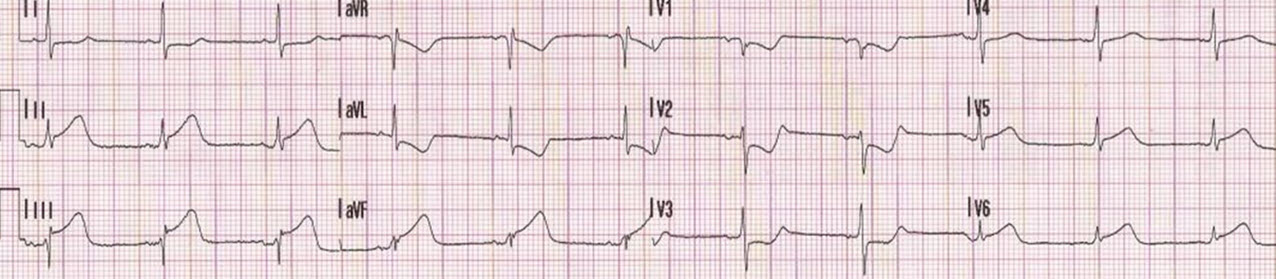
The observation that sometimes the reciprocal lead shows an inverted T wave and sometimes it does not can be understood through these scenarios:
- T wave inverted in the reciprocal lead (e.g., T-wave inversion in aVL during inferior STEMI/OMI): This occurs when the ischemia-modified T-wave vector is large enough and sufficiently aligned with the inferior-to-superior axis that it dominates the net T-wave vector. In this case, the T wave behaves more like a “true reciprocal” — the T-wave vector points inferiorly (toward the ischemic zone), and aVL, facing superiorly, records an inverted T wave. This is more likely when the ischemic territory is large, the ischemia is severe, and the non-ischemic myocardium’s contribution to the T-wave vector is relatively small. Hassen et al. (2014) noted that T-wave inversion in aVL can be an early reciprocal sign of inferior MI.4
- T wave upright in the reciprocal lead (e.g., T wave remains upright in aVL during inferior STEMI/OMI): This occurs when the non-ischemic myocardium’s repolarization gradients generate a T-wave vector component that is directed superiorly and leftward — toward aVL — and this component is large enough to keep the net T-wave vector pointing toward aVL’s positive pole despite the ischemia. The ST segment, being a larger and more directionally pure signal, still shows clear depression, but the T wave — being a composite of the entire ventricle’s repolarization — remains upright.
The additional nuance for limb leads specifically
Beyond the core principle (ST and T are generated differently), the limb lead system adds a specific geometric nuance that does not apply to the V1–V2/V7–V9 pair. The precordial leads V1–V2 and V7–V9 are almost exactly 180° opposite in the transverse plane, so the angular deviation is relatively small. But in the frontal plane, the limb lead pairs used as “reciprocals” are often far from 180° apart:
- aVL (−30°) and III (+120°) = 150° apart
- aVL (−30°) and aVF (+90°) = 120° apart
- I (0°) and III (+120°) = 120° apart
This means that the T-wave vector can easily fall in a direction that projects as upright in both the “primary” and “reciprocal” leads simultaneously — something that is geometrically much less likely for the V1/V7–V9 pair. The ST segment, being larger in magnitude, is less susceptible to this angular ambiguity, which is why ST reciprocity is more reliable than T-wave reciprocity in the limb leads.1,3
So, the same fundamental explanation applies — the ST segment and T wave are generated by different electrophysiologic mechanisms, and only the ST segment behaves as a clean reciprocal. However, the limb lead system introduces additional geometric variability (non-180° lead orientations, aVL’s perpendicular axis sensitivity) that makes T-wave reciprocal behavior even more inconsistent than in the precordial leads. Whether the reciprocal T wave is inverted or upright at any given moment depends on the balance between the ischemia-modified T-wave vector and the non-ischemic myocardium’s repolarization.
VI. Diagnostic Utility
The diagnostic utility of reciprocal ST-segment changes extends across several clinical domains.
Mimics of reciprocal changes.
Because reciprocal ST-segment depression is a powerful diagnostic clue in acute coronary occlusion, it is essential to recognize conditions that can mimic reciprocal changes — or, conversely, conditions that produce ST-segment elevation without reciprocal changes, thereby helping to exclude acute coronary occlusion.
Conditions that typically produce ST elevation without reciprocal depression.
Several conditions produce ST-segment elevation without reciprocal depression, and the absence of reciprocal changes in these settings is itself a useful differentiating feature.
- Acute pericarditis typically produces diffuse, concave-upward ST-segment elevation without reciprocal depression (except in lead aVR, where ST depression reflects the reciprocal of diffuse elevation elsewhere).6
- Early repolarization patterns similarly produce concave ST-segment elevation — most prominent in the precordial leads — without reciprocal depression in opposing leads.9
- Takotsubo syndrome (stress cardiomyopathy) may produce ST-segment elevation, but the distribution typically does not conform to a single coronary territory. ST-segment depression is uncommon in Takotsubo, occurring in fewer than 10% of patients, and its presence should suggest an alternate diagnosis of acute coronary syndrome.19
Conditions that produce ST depression mimicking reciprocal changes.
More problematic are conditions that produce ST-segment depression that can be mistaken for reciprocal changes when no acute coronary occlusion exists.
- Left ventricular hypertrophy (LVH) produces a “strain” pattern with ST-segment depression and T-wave inversion in the lateral leads (I, aVL, V5, V6), which can mimic reciprocal depression when ST elevation is present in other leads from a non-ischemic cause.
- Left bundle branch block (LBBB) produces secondary ST-T wave changes that are discordant to the QRS — ST depression in leads with dominant R waves and ST elevation in leads with dominant S waves — creating a pattern that can simulate both primary ST elevation and reciprocal depression simultaneously.
- Brugada syndrome produces ST-segment elevation confined to the right precordial leads (V1– V3). Notably, nearly half of patients with type 1 Brugada pattern show ST-segment depression ≥0.1 mV in the inferior leads, which can mimic reciprocal changes. This inferior ST depression in Brugada syndrome is not reciprocal to ischemic injury but rather reflects the orientation of the right ventricular outflow tract vector, which may be directed both superiorly and anteriorly when the outflow tract is horizontally oriented.20,21
Conditions that can produce ST elevation with apparent reciprocal depression — the most dangerous mimics.
Two conditions deserve special emphasis because they can produce focal ST-segment elevation with reciprocal depression in opposing leads, closely mimicking acute coronary occlusion.
- Acute myocarditis can produce segmental ST-segment elevation with reciprocal depression when inflammation is localized rather than diffuse. The AHA Scientific Statement on fulminant myocarditis notes that “electrocardiographic signs of an injury current with ST-segment elevations in contiguous leads in a segmental fashion are not uncommon and may mimic coronary occlusion.”22 The AHA pediatric myocarditis statement similarly notes that ST- segment changes “may be diffuse or in a defined coronary distribution pattern.”23 When myocarditis produces focal inflammation — as is common with parvovirus B19 involving the inferolateral wall — the resulting injury current can be localized enough to generate ST elevation in the inferior and lateral leads with reciprocal depression in the opposing leads, closely mimicking STEMI/OMI.24 Wieczorkiewicz et al. found that among young adults (≤45 years) presenting with ST elevation, 44% ultimately had myocarditis rather than MI confirmed by cardiac magnetic resonance.25 The classic teaching that myocarditis produces “diffuse” ST elevation without reciprocal changes applies only to cases with widespread myocardial involvement or concomitant pericarditis. The key differentiators are clinical context (recent infection, elevated CRP, younger age) and the noncoronary distribution of late gadolinium enhancement on CMR.26
- Hyperkalemia can produce a pseudoinfarction pattern with ST elevation and apparent reciprocal depression. Wang et al. describe the ST elevation in hyperkalemia as resulting from nonhomogeneous depolarization in different portions of the myocardium.27 When this nonhomogeneity is regionally predominant — which it can be, given that the conduction delay affects different myocardial segments unevenly — ST elevation in some leads can be accompanied by ST depression in opposing leads, producing what appears to be reciprocal change. Additionally, ST-segment depression is itself listed as a recognized ECG manifestation of hyperkalemia.28 The distinguishing feature is the typically downsloping morphology of the elevated ST segment (versus the plateau or upsloping morphology of true MI), along with the accompanying peaked T waves, QRS widening, and P- wave flattening.27,29
False STEMI/OMI activations remain a significant clinical problem. Agrawal et al. found that 22.7% of catheterization laboratory activations for suspected STEMI/OMI did not have acute coronary syndrome, with LVH (49%), early repolarization (24%), and right bundle branch block (16%) being the most common ECG causes of misdiagnosis. Recognizing whether the ST-segment depression on the ECG represents true reciprocal change or a mimic is therefore critical to avoiding unnecessary invasive procedures.30
Localizing the culprit artery and level of occlusion.
The specific pattern of reciprocal changes can help identify both the culprit coronary artery and the level of occlusion within that artery. ST-segment depression in leads I and aVL with ST elevation in inferior leads points to RCA or LCx occlusion, while ST depression in inferior leads with ST elevation in Leads I and aVL indicates LAD or LCx occlusion. [1] The distinction between proximal and mid-LAD occlusion can be refined by the presence or absence of reciprocal ST-segment depression (present only with proximal occlusion) in inferior leads.6
Identifying inferolateral (“posterior”) myocardial infarction.
Perhaps the most consequential diagnostic application of the reciprocal change concept is the recognition of posterior (lateral) STEMI/OMI. ST-segment depression in leads V1 and V2, particularly when it is the dominant ECG finding, should prompt consideration of inferolateral STEMI/OMI and the placement of posterior leads (V7, V8, V9) to confirm the diagnosis.1 Failure to recognize this reciprocal pattern may result in delayed or missed diagnosis of an otherwise treatable STEMI/OMI.
VII. Conclusion
Reciprocal ST-segment changes are a common, clinically meaningful, and diagnostically useful feature of the electrocardiogram in acute ST-elevation myocardial infarction. Present in approximately three-quarters of STEMI/OMI patients, they serve as diagnostic markers that help distinguish STEMI/OMI from its mimics, localize the culprit coronary artery and level of occlusion, and provide prognostic information regarding infarct size, left ventricular function, myocardial reperfusion, and mortality.
The ST segment is uniquely suited to reciprocal behavior because it reflects a monophasic injury current vector generated during the plateau phase of the ventricular action potential — a phase during which non-ischemic myocardium is electrically quiescent. The T wave, which reflects the heterogeneous and multiply influenced repolarization process, does not possess this property of generating a single, stable, directional vector amenable to reliable reciprocal projection across the 12-lead ECG.
The current weight of evidence supports the mirror reflection hypothesis as the primary mechanism of reciprocal changes, though their association with larger infarct size, multivessel disease, and global perfusion abnormalities indicates that they carry prognostic significance that extends beyond a simple electrical phenomenon. Clinicians should recognize reciprocal changes as important diagnostic and prognostic markers, be aware of the conditions that may mask or mimic them, and use their pattern and distribution to guide clinical decision-making in the acute management of myocardial infarction.
VIII. REFERENCES
- Wagner GS, Macfarlane P, Wellens H, et al. AHA/ACCF/HRS recommendations for the standardization and interpretation of the electrocardiogram: part VI: acute ischemia/infarction: a scientific statement from the American Heart Association Electrocardiography and Arrhythmias Committee, Council on Clinical Cardiology; the American College of Cardiology Foundation; and the Heart Rhythm Society. J Am Coll Cardiol. 2009;53(11):1003-1011. doi:10.1016/j.jacc.2008.12.016
- Wagner GS, Macfarlane P, Wellens H, et al. AHA/ACCF/HRS recommendations for the standardization and interpretation of the electrocardiogram: part VI: acute ischemia/infarction: a scientific statement from the American Heart Association Electrocardiography and Arrhythmias Committee, Council on Clinical Cardiology; the American College of Cardiology Foundation; and the Heart Rhythm Society. Circulation. 2009;119(10):e262-e270. doi:10.1161/CIRCULATIONAHA.108.191098
- Bayés de Luna A, Fiol-Sala M, Bayés-Genís A, et al. The ECG recording. In: Clinical Electrocardiography. Wiley; 2021:chap 6. ISBN: 9781119536451.
- Kligfield P, Gettes LS, Bailey JJ, et al. Recommendations for the standardization and interpretation of the electrocardiogram: part I: the electrocardiogram and its technology: a scientific statement from the American Heart Association Electrocardiography and Arrhythmias Committee, Council on Clinical Cardiology; the American College of Cardiology Foundation; and the Heart Rhythm Society. J Am Coll Cardiol. 2007;49(10):1109-1127. doi:10.1016/j.jacc.2007.01.024
- Sakaguchi S, Sandberg J, Benditt DG. ECG electrode reversals: an opportunity to learn from mistakes. J Cardiovasc Electrophysiol. 2018;29(5):806-815. doi:10.1111/jce.13450
- Thygesen K, Alpert JS, Jaffe AS, et al. Fourth universal definition of myocardial infarction (2018). J Am Coll Cardiol. 2018;72(18):2231-2264. doi:10.1016/j.jacc.2018.08.1038
- Noriega FJ, Jorge E, Arzamendi D, Cinca J. Mechanism and diagnostic potential of reciprocal ECG changes induced by acute coronary artery occlusion in pigs. Heart Rhythm. 2013;10(6):883-890. doi:10.1016/j.hrthm.2013.02.022
- Surawicz B. ST-segment, T-wave, and U-wave changes during myocardial ischemia and after myocardial infarction. Can J Cardiol. 1986;Suppl A:71A-84A.
- Rautaharju PM, Surawicz B, Gettes LS, et al. AHA/ACCF/HRS recommendations for the standardization and interpretation of the electrocardiogram: part IV: the ST segment, T and U waves, and the QT interval: a scientific statement from the American Heart Association Electrocardiography and Arrhythmias Committee, Council on Clinical Cardiology; the American College of Cardiology Foundation; and the Heart Rhythm Society. J Am Coll Cardiol. 2009;53(11):982-991. doi:10.1016/j.jacc.2008.12.014
- Thygesen K, Alpert JS, White HD; Joint ESC/ACCF/AHA/WHF Task Force for the Redefinition of Myocardial Infarction. Universal definition of myocardial infarction. J Am Coll Cardiol. 2007;50(22):2173-2195. doi:10.1016/j.jacc.2007.09.011
- Vaidya GN, Antoine S, Imam SH, et al. Reciprocal ST-segment changes in myocardial infarction: ischemia at distance versus mirror reflection of ST-elevation. Am J Med Sci. 2018;355(2):162-167. doi:10.1016/j.amjms.2017.09.004
- Camara EJ, Chandra N, Ouyang P, Gottlieb SH, Shapiro EP. Reciprocal ST change in acute myocardial infarction: assessment by electrocardiography and echocardiography. J Am Coll Cardiol. 1983;2(2):251-257. doi:10.1016/s0735-1097(83)80160-0
- Radwan HI, Mohamed AAE, Ammar AS, Roshdy HS. Relation of collateral circulation with reciprocal changes in patients with acute ST-elevation myocardial infarction. J Electrocardiol. 2020;60:36-43. doi:10.1016/j.jelectrocard.2020.03.011
- Liga R, Orsini E, Caravelli P, et al. Interactions between reciprocal ST-segment downsloping during ST-elevated myocardial infarction and global cardiac perfusion and functional abnormalities. Am J Cardiol. 2017;119(12):1902-1908. doi:10.1016/j.amjcard.2017.03.015
- Dewhurst NG, Muir AL. Clinical significance of “reciprocal” S-T segment depression in acute myocardial infarction: relative contributions of infarct size and ischemia at a distance. Am J Med. 1985;78(5):765-770. doi:10.1016/0002-9343(85)90281-5
- Ali Amghaiab IF, Khaddr M, Ali FI. Decoding South African flag sign — when lead V2 speaks volumes. JAMA Intern Med. 2025;185(11):1389-1390. doi:10.1001/jamainternmed.2025.1400
- Bayés de Luna A, Fiol-Sala M, Bayés-Genís A, et al. Ischemia and necrosis. In: Clinical Electrocardiography. Wiley; 2021:chap 13. ISBN: 9781119536451.
- Driver BE, Khalil A, Henry T, Kazmi F, Adil A, Smith SW. A new ECG finding in posterior STEMI: the posterior reperfusion T wave. Am J Emerg Med. 2017;35(10):1530-1534. doi:10.1016/j.ajem.2017.07.030
- Medina de Chazal H, Del Buono MG, Keyser-Marcus L, et al. Stress cardiomyopathy diagnosis and treatment: JACC state-of-the-art review. J Am Coll Cardiol. 2018;72(16):1955-1971. doi:10.1016/j.jacc.2018.07.072
- Brugada J, Campuzano O, Arbelo E, Sarquella-Brugada G, Brugada R. Present status of Brugada syndrome: JACC state-of-the-art review. J Am Coll Cardiol. 2018;72(9):1046-1059. doi:10.1016/j.jacc.2018.06.037
- Crea P, Picciolo G, Luzza F, Oreto G. A three-dimensional computed model of ST segment abnormality in type 1 Brugada pattern: a key role of right ventricular outflow tract orientation? J Electrocardiol. 2019;53:31-35. doi:10.1016/j.jelectrocard.2018.12.013
- Kociol RD, Cooper LT, Fang JC, et al. Recognition and initial management of fulminant myocarditis: a scientific statement from the American Heart Association. Circulation. 2020;141(6):e69-e92. doi:10.1161/CIR.0000000000000745
- Law YM, Lal AK, Chen S, et al. Diagnosis and management of myocarditis in children: a scientific statement from the American Heart Association. Circulation. 2021;144(6):e123-e135. doi:10.1161/CIR.0000000000001001
- Ammirati E, Moslehi JJ. Diagnosis and treatment of acute myocarditis: a review. JAMA. 2023;329(13):1098-1113. doi:10.1001/jama.2023.3371
- Wieczorkiewicz P, Przybylak K, Supel K, Kidawa M, Zielinska M. Symptomatic young adults with ST-segment elevation — acute coronary syndrome or myocarditis: the three-factor diagnostic model. J Clin Med. 2022;11(4):916. doi:10.3390/jcm11040916
- Basso C. Myocarditis. N Engl J Med. 2022;387(16):1488-1500. doi:10.1056/NEJMra2114478
- Wang K, Asinger RW, Marriott HJL. ST-segment elevation in conditions other than acute myocardial infarction. N Engl J Med. 2003;349(22):2128-2135. doi:10.1056/NEJMra022580
- Mozos I. Laboratory markers of ventricular arrhythmia risk in renal failure. Biomed Res Int. 2014;2014:509204. doi:10.1155/2014/509204
- Lee JZ, Asirvatham SJ. Metabolic disturbances for the electrophysiologist. J Cardiovasc Electrophysiol. 2019;30(10):2147-2149. doi:10.1111/jce.14139
- Agrawal A, Lu M, Kanjanahattakij N, et al. ECG clues for false ST-segment elevation myocardial infarction activations. Coron Artery Dis. 2019;30(6):406-412. doi:10.1097/MCA.0000000000000716
- Kligfield P, Gettes LS, Bailey JJ, et al. Recommendations for the standardization and interpretation of the electrocardiogram: Part I: the electrocardiogram and its technology: a scientific statement from the American Heart Association. J Am Coll Cardiol. 2007;49(10):1109-1127. doi:10.1016/j.jacc.2007.01.024
- Ali Amghaiab IF, Khaddr M, Ali FI. Decoding South African flag sign — when lead V2 speaks volumes. JAMA Intern Med. 2025;185(11):1389-1390 — already in the article reference list as reference 17
- Gao Q, Bie F, Hu Y, Chen Y, Yang B. Characteristics and mechanism of reciprocal ST-segment depression in acute ST segment elevation myocardial infarction. Medicine. 2022;101(44):e31238. doi:10.1097/MD.0000000000031238